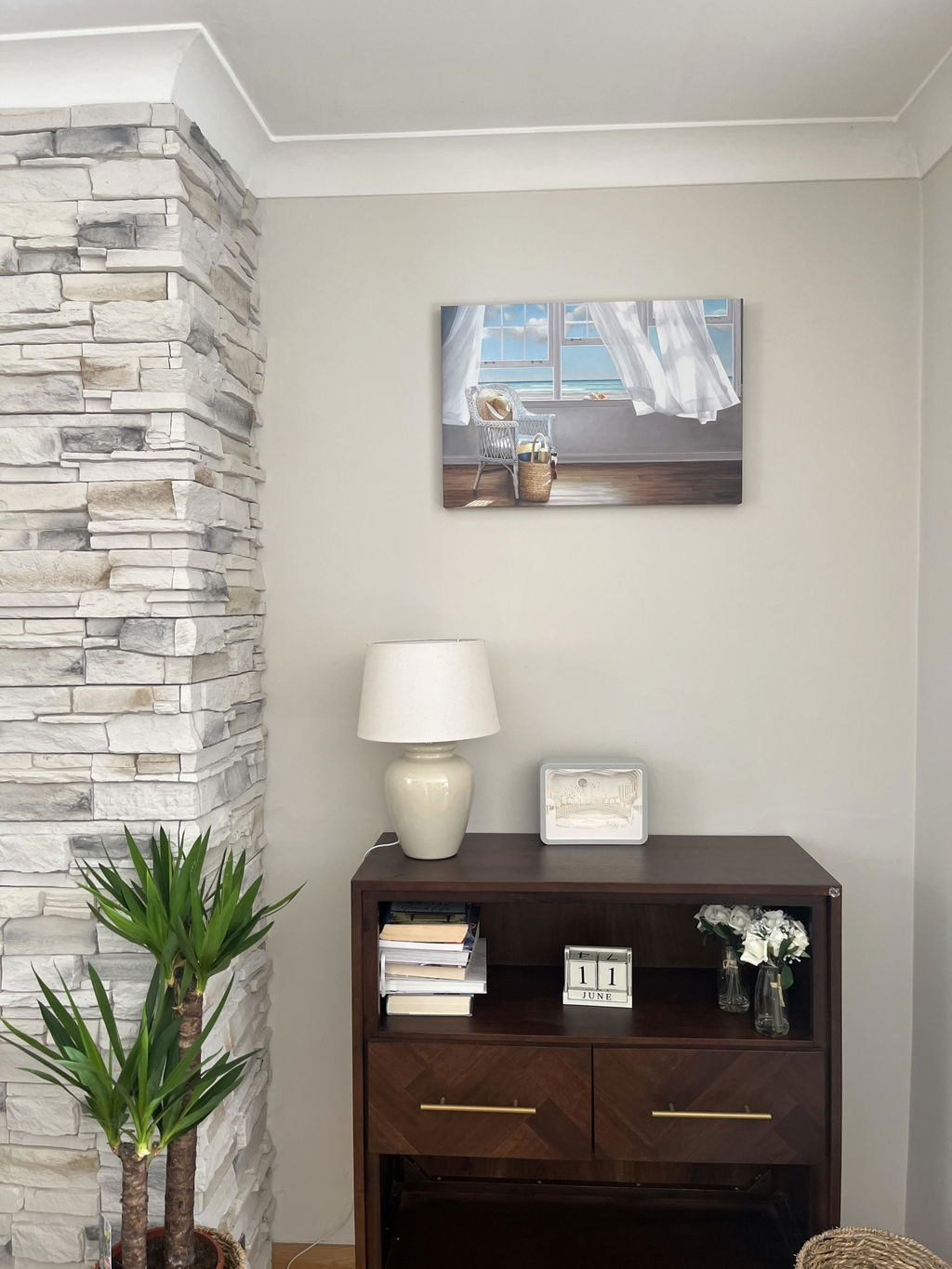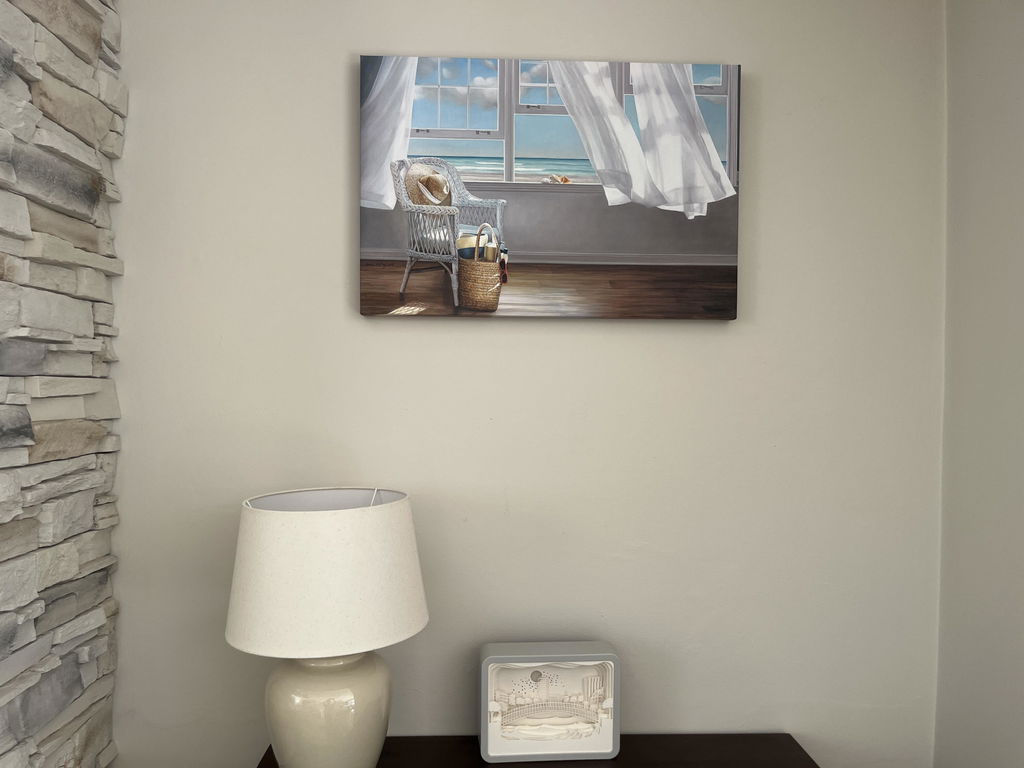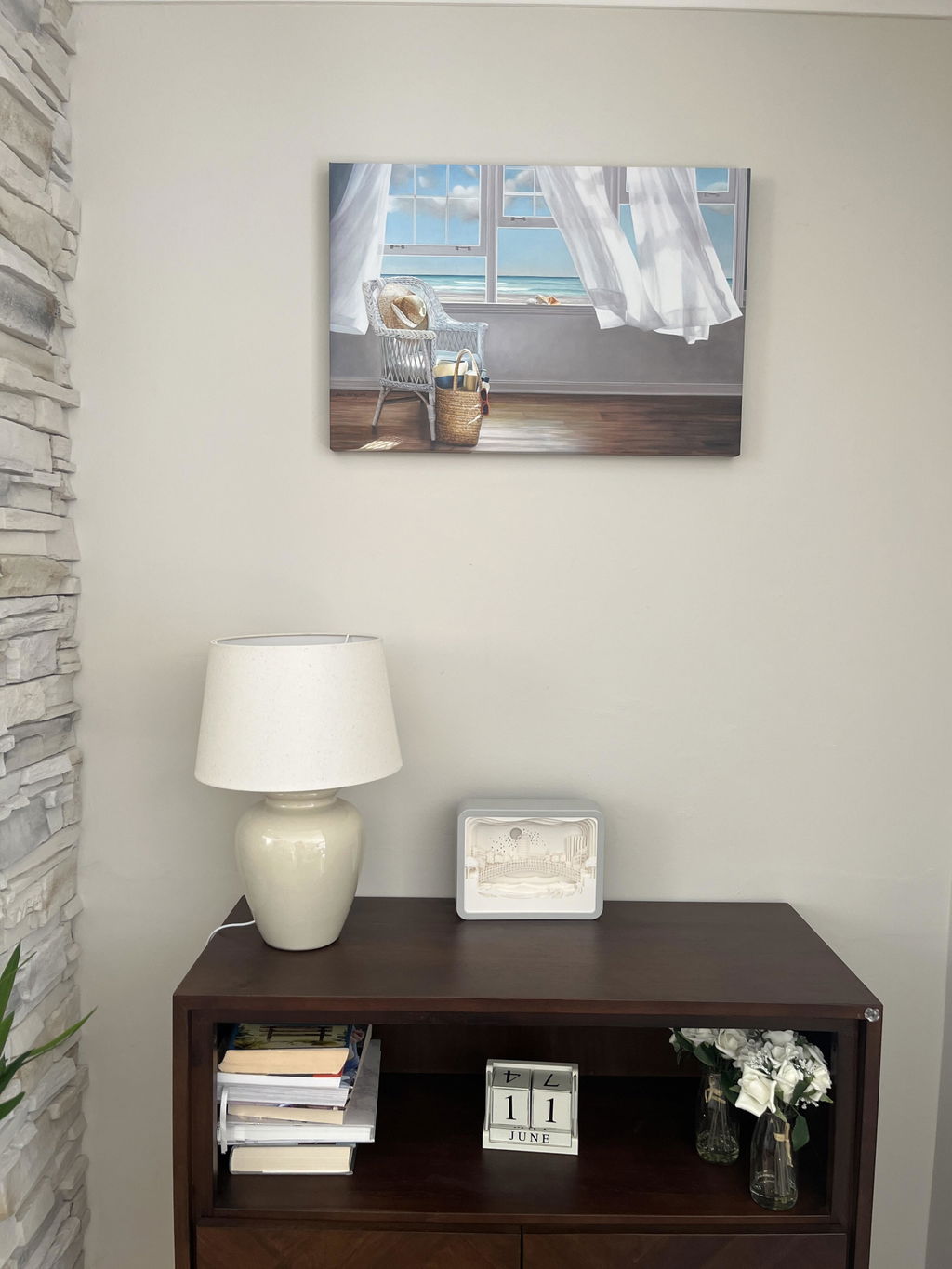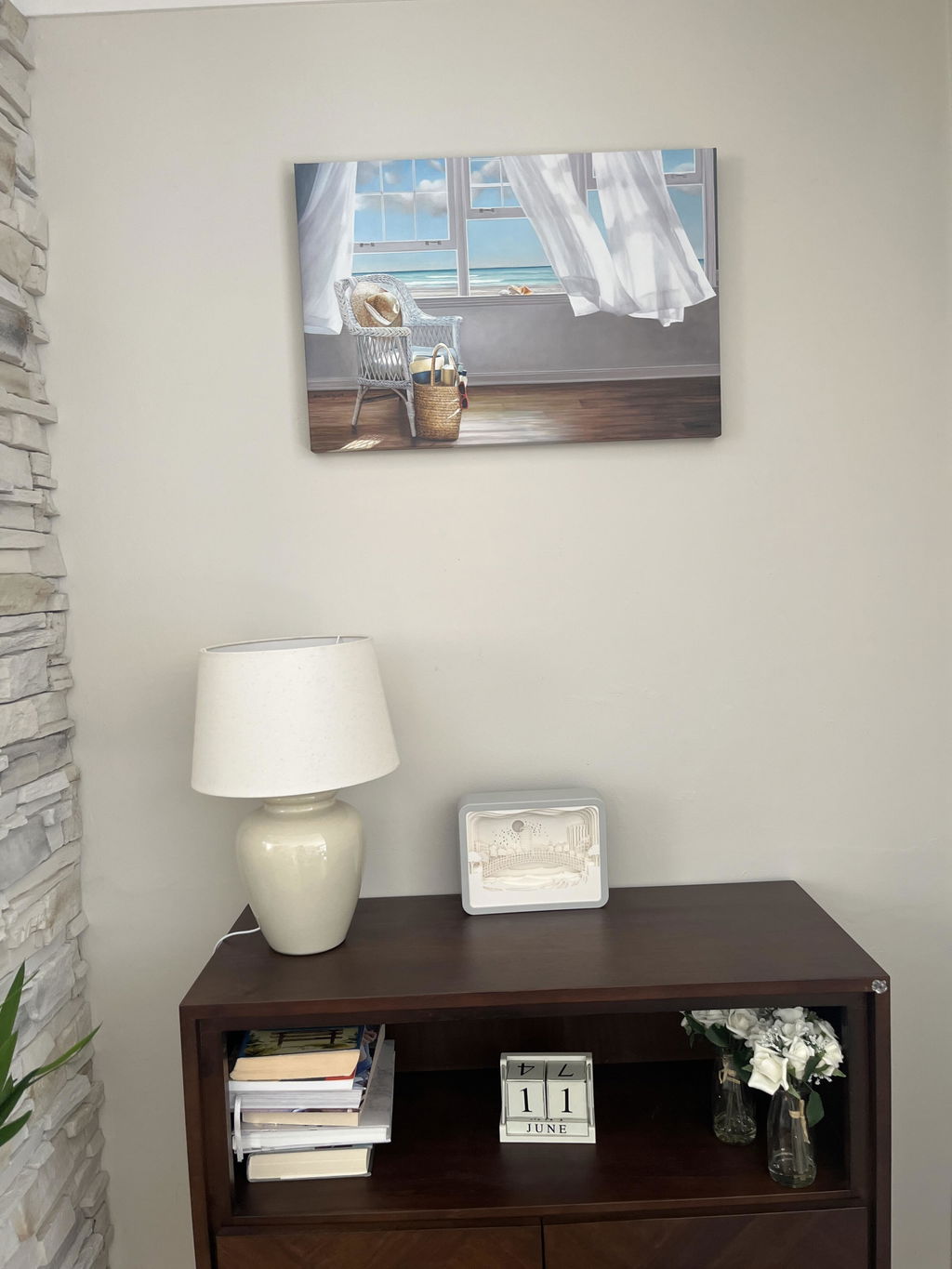

You've got the table, the chairs, and the light fixture. The room is functional, polished, and somehow still feels unfinished. That's the point where most dining rooms stall out. The furniture handles the job, but the walls don't help tell the story.
Dining room wall art is usually the missing layer. It softens hard lines, gives the eye somewhere to land, and turns a room used for daily meals into a room people remember. In open-plan homes, it matters even more because the dining area rarely stands alone. It's seen from the kitchen, from the sofa, and often from the entry too.
Table of Contents
- From Dining Space to Statement Room
- Defining Your Dining Room's Aesthetic
- Mastering Scale and Proportion
- Arrangement Strategies Statement Piece or Gallery Wall
- Wall Art for Open-Plan Living Spaces
- Choosing Your Perfect Print and Frame
- Common Dining Room Art Questions
From Dining Space to Statement Room
A dining room can look complete on paper and still feel emotionally flat. I see this often in well-furnished homes. The table is centered, the chairs are right, the chandelier is doing its job, but the room has no visual conversation happening at eye level. That's why bare walls read as absence, not simplicity.
Wall art changes the room's role. It doesn't just decorate. It helps define whether the space feels formal, relaxed, layered, architectural, playful, or quiet. One strong piece can make a standard dining setup feel intentional. A grouped arrangement can make the room feel lived in and collected.

That shift isn't new. The White House history of the State Dining Room notes that the room now seats as many as 140 guests and once served other purposes, including a drawing room, office, and Cabinet Room. That evolution matters because it shows how dining spaces moved from purely functional use into rooms where presentation and atmosphere became part of entertaining.
A dining room without art often feels like it's waiting for permission to become part of the home.
If your room feels restrained, the problem usually isn't that you need more furniture. It's that the room has no focal authority. Art gives it that. For oversized walls or awkward expanses, I like referring readers to Miller Waldrop's design solutions because they're useful for thinking through scale before you buy.
If your style leans pared back, this minimalist wall decor approach is a good reminder that simplicity doesn't mean leaving the wall empty. It means choosing fewer things with more intention.
Defining Your Dining Room's Aesthetic
Many individuals start by saying they want something modern, rustic, classic, or minimal. That's too broad to be useful. Good dining room wall art starts with a more specific question. How do you want the room to feel when people sit down?
Start with mood, not labels
A dining room used for long dinners needs different energy than one used for quick family meals. In one space, you might want softness and calm. In another, you may want contrast, color, and a little tension to keep the room lively.
Look at what's already fixed in the room:
- The wood tone: warm oak, dark walnut, black-stained wood, painted finishes
- The upholstery: crisp, structured, casual, textured, formal
- The light quality: bright daylight, moody evening glow, mixed light from nearby spaces
- The visual weight: whether the room already feels heavy, airy, structured, or loose

When I help clients narrow choices, I ask them to describe the room as if it were hosting someone. Welcoming and relaxed? Refined and dressy? Earthy and grounded? Clean and architectural? Those words are more useful than a style label because they shape color, subject matter, and framing.
Build a usable color story
Don't match art to the wall color alone. Pull from the room's quieter elements. A rug border, chair fabric, drapery lining, ceramic centerpiece, or even your favorite dinnerware pattern can give you a far more interesting palette.
Here's a practical way to build a brief before you shop:
- Choose one anchor tone from the largest element after the walls, usually the rug, chairs, or table.
- Add one supporting color that appears elsewhere in the connected space.
- Decide on contrast level. Do you want the art to blend, punctuate, or bridge?
- Pick a theme category such as abstract, natural scenery, botanical, figure-based, or graphic.
A calm room usually benefits from tonal variation rather than loud contrast. A room with heavy wood furniture often looks better when the art brings in some lift, either through lighter negative space or a fresher color note. If the room is already pale and quiet, art can carry more drama.
Practical rule: If you can't describe your ideal artwork in one sentence, you're not ready to shop yet.
One reason people get overwhelmed is too much choice with no filter. A color-first search helps. If you're trying to align your wall art with an existing palette, this guide to decorating with 2026 colors is useful for translating trend language into rooms that still feel personal instead of forced.
Mastering Scale and Proportion
Nothing makes dining room wall art look accidental faster than poor scale. A beautiful piece that's too small will still look wrong. A modest piece with the right proportions will look more expensive and more settled.
Start with measurement, not instinct.

Use the table as your measuring tool
A practical sizing method is to choose art that spans roughly 50% to 75% of the width of the table or wall, with the two-thirds rule as a strong starting point. One guide explains that a 60-inch dining table pairs well with art that is at least 40 inches wide for visual balance, as outlined in Rossetti Art's dining room sizing guide.
That range gives you structure without making the room feel rigid. For one large wall, I'd rather see a piece with presence than several small works floating in too much blank space.
A quick reference helps:
| Situation | What tends to work |
|---|---|
| Narrow wall behind a compact table | One horizontal piece with clear visual weight |
| Wide wall with buffet | One oversized work or a tightly unified grouping |
| Small dining area | One larger statement piece instead of scattered small frames |
| Formal room with symmetry | Art centered carefully to reinforce order |
If you're leaning bold, this oversized art decorating guide is helpful for seeing how larger work can anchor a room without making it feel crowded.
Hang it where the room actually sees it
Placement matters as much as size. The same Rossetti guidance recommends keeping the bottom edge about 8 to 12 inches above the table or buffet and centering the work around 54 to 57 inches from the floor. A related dining-room styling guide also notes that art is often hung so the center sits around 57 to 60 inches above the floor, which aligns with standard eye-level practice in interiors, as described in Rossetti Art's wall art advice for dining rooms.
Those numbers aren't arbitrary. They help the art relate to the furniture below it and to the people using the room. Dining rooms are seen both seated and standing, so placement needs to feel natural from both angles.
This visual walkthrough can help if you want a quick placement refresher:
What usually goes wrong
The most common mistake is buying art that's too small. It creates visual fragmentation. The wall, table, and artwork never read as one composition.
Other mistakes show up regularly too:
- Hanging too high: the art disconnects from the furniture and starts floating.
- Overfilling a small wall: too many pieces create fuss where one clean move would look stronger.
- Ignoring frame thickness: bulky frames can make a modest piece feel even smaller.
- Choosing by website thumbnail: scale that feels dramatic on a screen often feels timid on a real wall.
If you're unsure between two sizes, go larger. In dining rooms, restraint usually comes from editing the number of pieces, not shrinking the art.
Arrangement Strategies Statement Piece or Gallery Wall
Once size is sorted, the next decision is layout. Most dining rooms want one of two things. A clear focal point. Or a curated collection that builds personality across the wall.

When one large piece works best
A statement piece creates clarity. It tells the room what the focal point is immediately. This approach works especially well when the dining room is compact, when the furniture lines are already busy, or when the architecture needs calming rather than extra detail.
Choose a single large work if you want the room to feel:
- Cleaner: fewer elements competing for attention
- More architectural: one shape reinforcing the structure of the wall
- Less cluttered: especially important in smaller homes
- More contemporary: even traditional rooms benefit from one confident move
I often steer people in this direction when they're torn, because one strong piece is easier to scale correctly and harder to make messy.
When a gallery wall makes more sense
A gallery wall brings narrative. It can show travel memories, a mix of mediums, or a color story that develops across several frames. But it only works when the grouping reads as a single composition from a distance.
Treat it as one unit, not separate floating pieces. Keep the outer edges intentional. Repeat something across the arrangement, such as frame finish, mat style, subject, or palette, so the display feels curated rather than improvised.
The difference between collected and chaotic is usually planning.
For placement mechanics, this precision art hanging guide is a practical reference if you want help getting spacing and alignment under control.
A simple comparison makes the choice easier:
| If you want... | Choose... |
|---|---|
| Drama with simplicity | One statement piece |
| Personal storytelling | Gallery wall |
| Less visual noise | One statement piece |
| More layered character | Gallery wall |
If you like the look of grouped panels but want more structure than a mixed gallery wall, three-piece wall art layouts offer a nice middle ground. They give you rhythm without the unpredictability of many unrelated frames.
Wall Art for Open-Plan Living Spaces
Most dining room wall art advice falls short. It treats the dining area like a sealed room. Many homes don't work that way anymore. The dining table sits between the kitchen and living area, and the wall art has to hold up from several angles at once.
A key challenge in modern decorating is choosing dining room art for open-plan homes without creating visual conflict with adjacent zones. Guidance on the subject often stays generic, even though the art has to coordinate with multiple sightlines and help unify the connected layout rather than fragment it, as discussed in Havenly's dining room wall decor guidance.
Think in sightlines, not rooms
Stand in the kitchen. Then sit on the sofa. Then walk in from the entry if that view connects. The right artwork should make sense from all of those positions.
That changes how you choose:
- Color has to travel. A tone that appears only in the dining area can feel isolated. Repeating a color already present in the living room or kitchen makes the art feel integrated.
- Frame finish needs context. Black, oak, brass, white, or natural wood frames all speak to nearby cabinets, hardware, lighting, and furniture.
- Subject matter affects zoning. Highly thematic dining art can feel too literal in an open layout. More flexible imagery often connects zones better.
A dining area doesn't need to match the living room exactly. It needs to belong to the same household language.
Use art as a visual bridge
The best open-plan dining art often acts as a bridge between neighboring spaces. It may borrow the warmth of the kitchen wood tones and the softness of the living room textiles. Or it may introduce one accent color that already appears in both areas in smaller ways.
I like to think of three workable strategies:
| Strategy | Best for | What it does |
|---|---|---|
| Palette bridge | Homes with mixed finishes | Pulls colors from adjacent zones |
| Frame bridge | Rooms with strong hardware or wood tones | Connects art to furniture and built-ins |
| Mood bridge | Spaces with different functions but similar atmosphere | Keeps the home feeling cohesive |
This is also where scale becomes more nuanced. In an open plan, tiny dining room wall art often disappears when viewed from farther away. The piece may look acceptable at the table and underwhelming from the kitchen island. That's why many open-plan homes benefit from work with stronger mass, cleaner composition, and enough contrast to read from across the space.
In connected layouts, the wall art shouldn't just finish the dining room. It should help stitch the whole floor plan together.
If your dining zone sits close to the kitchen, this kitchen art perspective can help you think through coordination without making the two spaces feel repetitive.
Choosing Your Perfect Print and Frame
Material choice changes how art behaves in a dining room. It affects glare, texture, visual sharpness, and whether the piece feels crisp or relaxed. This part gets overlooked because people focus on the image first. In the room, the finish and frame often make the difference between “good enough” and “that looks right.”
Match the format to the job
A few formats tend to serve different needs well:
- Framed print: best when you want a polished, finished look without adding another project later.
- Premium textured paper print: a good choice when you want a matte, fine-art feel with more surface character.
- Unframed satin print: useful if you want flexibility or already have a framer and a very specific frame style in mind.
- Canvas print: works well when you want softness, less reflection, and a more casual or contemporary presence.
Dining rooms often benefit from lower-glare finishes, especially if there's a chandelier, nearby windows, or reflective kitchen surfaces in view. If the room gets strong daylight, glass choice and paper finish matter more than people expect.
Why the frame changes everything
Frame style isn't trim. It's part of the design language. A thin black frame sharpens contemporary work. Natural oak softens graphic art and connects beautifully with lighter woods. A wider traditional frame can make a classic piece feel more formal, but it can also add unnecessary heaviness in a room that already has substantial furniture.
Think about the frame in relation to the table base, chair lines, lighting metal, and cabinetry nearby. In open-plan homes, that connection matters even more because the frame becomes one of the clearest transition details between zones.
For delivery and protection, proper packaging matters too. If you've ever received a damaged frame, you know how frustrating that is. Products like picture frame foam corner protection from The Box Warehouse are a good example of the kind of protective detail that helps framed work arrive in good condition.
Common Dining Room Art Questions
How do I light my new wall art
Start simple. If the room already has a chandelier, see how the art looks in evening light before adding anything. Many pieces don't need dedicated picture lighting if the ambient light is warm and balanced.
If the wall still feels dim, consider a plug-in picture light, a nearby lamp on a buffet, or adjustable wall sconces if the layout supports them. Aim for soft emphasis, not theatrical spotlighting. You want the art to glow gently, not compete with the table.
What's the best way to hang art in a rental without damaging walls
Use removable hanging hardware only if the weight and wall surface support it. Lightweight pieces are the safest candidates. Heavier framed work usually needs more secure mounting, so renters often do best with lean-on styling on a picture ledge or buffet when wall damage is a concern.
Test placement first with paper templates and painter's tape. That step saves a lot of patching and repositioning.
Can I hang art on wallpaper or a textured wall
Yes, but you need to respect the surface. On textured walls, standard hooks can tilt the frame unevenly, so use hardware that stabilizes the piece. On wallpaper, measure carefully and avoid repeated repositioning because the surface can mark or tear.
If the wallpaper is bold, keep the art simpler and let the frame define the edges. If the wall texture is pronounced, artwork with enough scale and visual clarity usually reads better than something delicate and highly detailed.
The right dining room wall art doesn't just fill a blank space. It gives the room rhythm, identity, and a reason to feel finished. If you want to explore artwork by color, format, orientation, and style, Printano makes it easier to narrow the field and find a piece that fits both your room and the way you live.