
You have two quotes in your inbox for the same home, and they do not line up. One number is lower. The other names more rooms, a longer first visit, and time to air the house out after the team leaves. The cheaper line is tempting. The written scope sets the price, and how products are applied and how rooms are ventilated are part of what that price buys.
House cleaning services look interchangeable until the task lists sit side by side. A label such as standard clean can mean a quick wipe or a full reset of kitchens and baths. The sections below sort service types, what a normal visit includes and skips, how a visit should run, what moves the price, and which answers on a quote are worth trusting.
Table of Contents
- Service Types Compared at a Glance
- What a Standard Visit Covers and Leaves Out
- How a Typical Visit Runs From Start to Finish
- Booking Independent Cleaners Through Simply Maid
- What Moves the Price of a Cleaning Visit
- Quote Items and Red Flags to Check
- Three Homes and the Right Choice for Each
- Confirm Your Scope Before Booking Your First Visit
Service Types Compared at a Glance
The service type sets the scope, the rhythm, and the price before anyone talks about square footage. Two bids only compete when they describe the same kind of job. Cleaning is a large industry, not a side errand. Grand View Research valued the global cleaning-services market at $442.1 billion in 2025. That scale is why offers range from a light recurring visit to a one-time empty-home reset.
The ranges below are rough US estimates to check with local providers. Move-in and short-stay prices are not confirmed here as a national figure, so those rows tell you what to request in writing.
| Service type | Typical scope | How often | Typical US price | Best for |
|---|---|---|---|---|
| Standard recurring | Dusting, vacuuming, mopping, kitchen and bathroom surfaces | Weekly, biweekly or monthly | About $120-$200 for an average home | Ongoing upkeep |
| Deep clean | Standard tasks plus baseboards, grout attention, light fixtures and cabinet fronts | Once or seasonally | About $250-$450 for an average home | First visit or catching up |
| Move-in or move-out | Empty-home clean including inside cabinets, appliance interiors and wall spot cleaning | One time | Written empty-home quote, confirm locally | Leases and home sales |
| Post-construction | Fine dust removal from all surfaces, vents and fixtures | One time, after work finishes | Quoted by scope, often $400 or more | Renovated homes |
| Short-stay turnover | Checklist reset of beds, linens, bathrooms, kitchen and restocking | Per guest checkout | Per-checkout quote, confirm locally | Rental hosts |
| Window or carpet specialist | Interior and exterior glass, or carpet extraction | As needed | Quoted by number of windows or rooms | Single targeted jobs |
Standard recurring covers routine dusting, vacuuming, mopping, and kitchen and bathroom surfaces on a weekly, biweekly, or monthly rhythm. It holds a home that is already in decent shape.
Deep cleans add baseboards, grout attention, light fixtures, and cabinet fronts. They usually serve as a first visit or a seasonal reset, not as the forever price.
Move-in and move-out work targets an empty home, including appliance interiors and the inside of cabinets. Ask for that empty-home list in writing, because a furnished standard clean will miss the handover.
Post-construction removes fine dust from surfaces, vents, and fixtures, and it is quoted by how much dust the job left behind. Short-stay turnovers are checklist resets between guests, often on a same-day clock. Window and carpet work are usually separate bookings, priced by panes or rooms rather than folded into a weekly visit.
Practical rule: Pick the service type that matches the job, then compare quotes only inside that type.
What a Standard Visit Covers and Leaves Out
A standard visit is a task list, not a label. The same two words can hide very different work, which is why a lower price sometimes means fewer rooms, not a better deal.
| Task | Usually included | Often extra or excluded |
|---|---|---|
| Dusting | Reachable surfaces, furniture tops, light switches | High ceilings, blinds, decorative collections |
| Floors | Vacuuming and mopping of open floor areas | Carpet shampooing, stripping and sealing hard floors |
| Kitchen | Counters, sink, stovetop and exterior of appliances | Inside oven, inside fridge, cabinet interiors |
| Bathrooms | Toilet, tub and shower, sink, mirror | Mold removal, grout restoration, caulk replacement |
| Beds and linens | Making beds when linens are already on them | Laundry, ironing, changing bedding in some plans |
| Windows | Interior sills and accessible glass on request | Exterior glass, screens, window tracks |
| Walls and ceilings | Spot wipes at touch height | Full wall washing, ceilings and cobwebs in high rooms |
| Heavy soil and special jobs | Light pet hair and everyday grime | Pet waste, heavy grease, post-renovation dust, mold |
Why the line sits where it does
Dusting stays at reachable height because ladders, fragile collections, and blinds take extra time and a different risk. High ceilings and art objects belong on an add-on list, not in a silent assumption.
Floors mean vacuuming and mopping open areas. Shampooing carpet or stripping and sealing hard floors needs different machines, dry time, and a separate booking.
Kitchens get counters, the sink, the stovetop, and the outside of appliances. The inside of the oven, the fridge, and the cabinets is slower, greasier work, so most plans price it apart.
Bathrooms usually include the toilet, tub, shower, sink, and mirror. Mold removal, grout restoration, and new caulk are repair or specialist jobs, not a weekly scrub.
Beds are made when the linens are already on them. Laundry, ironing, and changing sheets are often excluded or billed on their own because they tie up a machine and a person.
Windows on a standard visit usually means interior sills and glass you can reach, and only when you ask. Exterior glass, screens, and tracks are a different visit.
Walls and ceilings get spot wipes at touch height. Full wall washing and high cobwebs are not the same task. Heavy soil, pet waste, built-up grease, and post-renovation dust sit outside a standard visit because they change the time, the products, and sometimes the crew.
If two quotes list different tasks, the lower price may mean less work. Ask for both lists side by side before you decide.
How a Typical Visit Runs From Start to Finish
A reliable visit follows a sequence. Skipping a step is how dust lands on a counter you already paid to have wiped, or how a disinfectant dries before it can work.
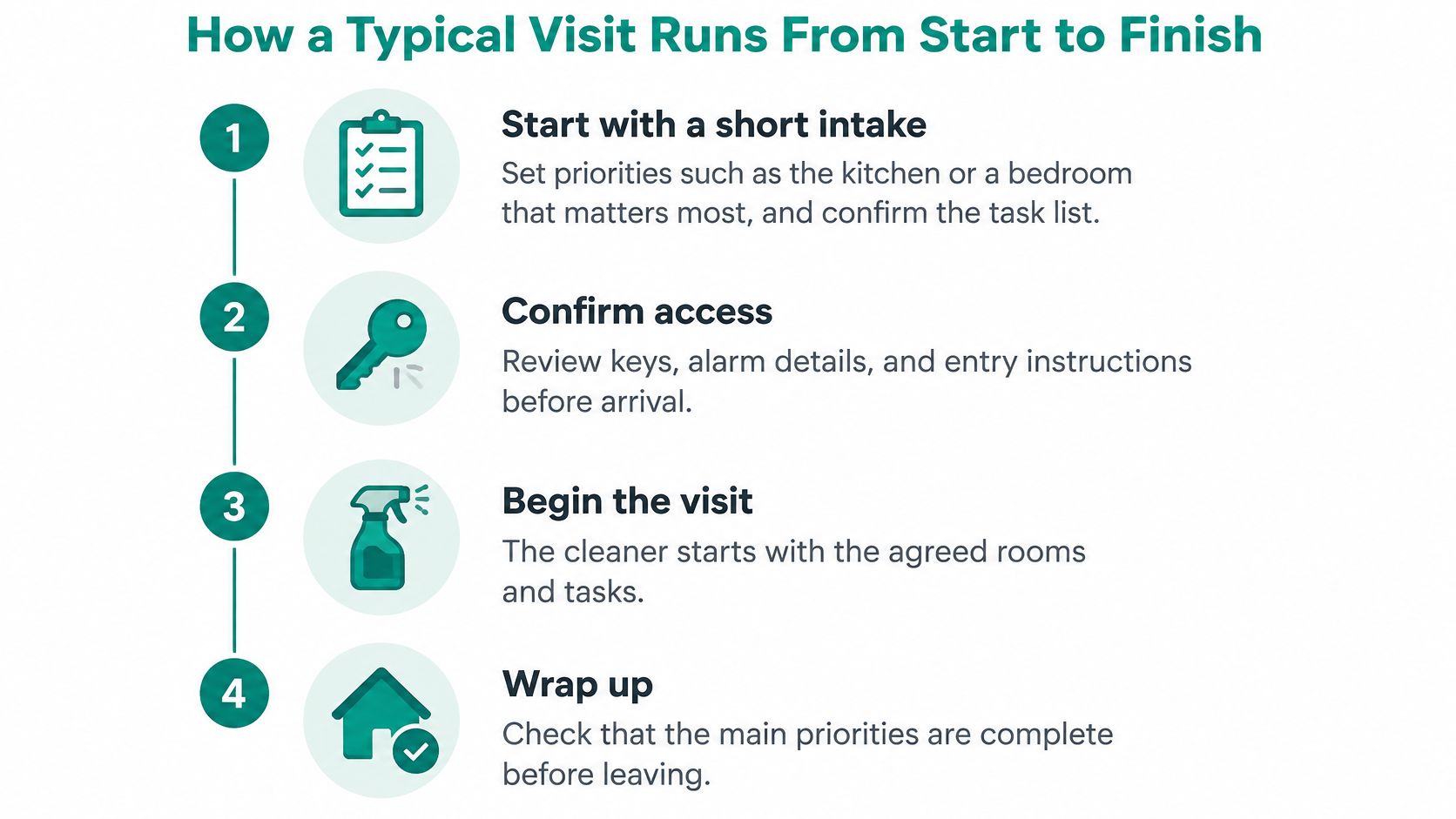
- Start with a short intake. Name the priority, such as the kitchen or one bedroom, and confirm the written task list. The common slip is starting without that list, then arguing later about what was promised.
- Confirm access. Keys, alarm codes, pets, and off-limits rooms should be settled before anyone arrives. A missed code burns paid time and leaves a room untouched.
- Set up supplies. Use labeled products at the dilution the manufacturer states, and do not mix products unless the label allows it. Guessing a stronger mix does not clean better, and it can damage a surface or the person using it.
- Work top to bottom, room by room. Dust falls onto floors that have not been finished yet, so vacuuming and mopping come last. Cleaning the floor first, then dusting above it, undoes the visit.
- Treat baths and the kitchen with dedicated cloths. Soil comes off first so a disinfectant can reach the surface, and that product has to stay wet for the time on the label. Rushing the wet time is the usual miss.
- Ventilate where it is safe. Vacuuming stirs dust, and some sprays linger. People with asthma or allergies should leave the room while the vacuum runs. Closing every window to "keep the smell in" is the wrong goal.
- Walk the list before anyone leaves. Check each room against the written tasks and fix misses on site. Teams that skip this step hear about streaks only after they are gone.
- Sign off and give feedback. A short note on what worked sets the standard for the next visit. Silence gets treated as approval.
What you should see when you walk back in
Surfaces should be dry and free of streaks. Floors should look even, not patchy where a mop stopped early. Bathrooms should smell of cleaner that has aired out, not of a heavy fragrance sitting in a closed room.
An eco label does not settle the exposure question. A 2025 residential monitoring study found that professional cleaning was followed by concentration increases in approximately 60% of measured volatile organic compounds and 80% of measured semivolatile organic compounds, and many of those compounds lack toxicity data. Ask how products are applied, how long surfaces stay wet, and how rooms are ventilated afterward, not only which bottle is used.
Booking Independent Cleaners Through Simply Maid
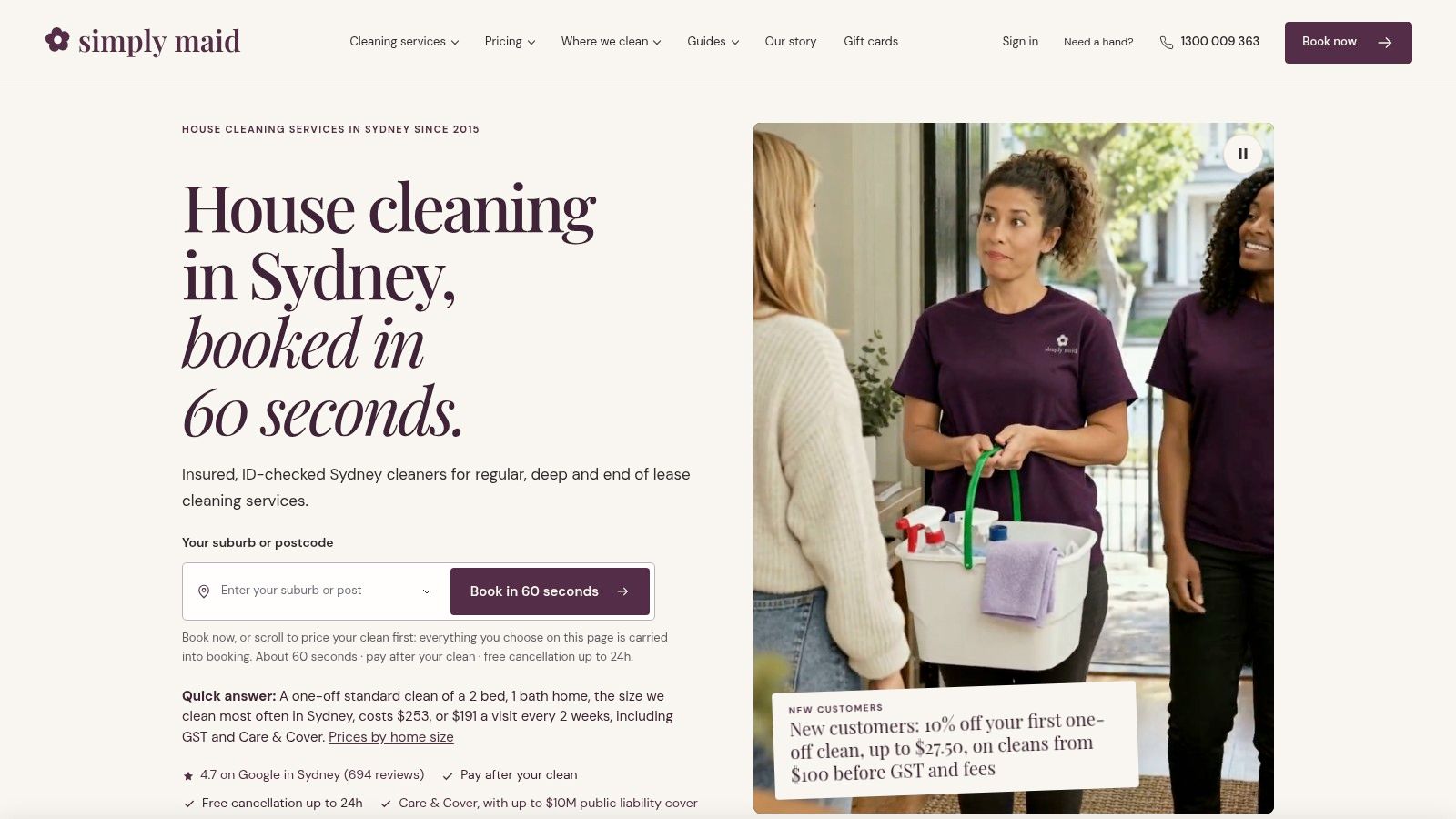
Scope is easier to judge when the booking page already separates a routine visit from a deep clean, an empty-home clean, and add-ons. House cleaning services arranged through Simply Maid follow that split. The Australian platform, founded by Huy Hoang in Sydney in 2015, books residential and commercial work with independent cleaning professionals and handles scheduling and support. Coverage includes Sydney, Melbourne, Brisbane, Perth, Adelaide, the Gold Coast, and Canberra.
What the booking actually covers
A standard residential visit takes kitchen surfaces, stovetops, bathrooms, vacuuming, mopping, and dusting. You can book once, weekly, fortnightly, or every four weeks. A deep clean adds ovens, rangehoods, dishwashers, skirting boards, door frames, grout, fans, and window tracks. End-of-lease and move-in work is for empty homes and includes cupboard and wardrobe interiors, ovens, refrigerators, and interior windows.
Carpet and upholstery use hot-water extraction where the material allows, including sofas, mattresses, and rugs. Commercial visits cover offices, retail, gyms, and shared spaces, starting at two cleaner-hours, as a one-off or up to four times a week. Extras, self-managed NDIS cleaning, gift cards, and printable planning guides sit alongside the core bookings.
Price, cover, and when it fits
Residential prices use bedroom and bathroom counts, not a vague dwelling type. Published prices include GST, supplies, and the Care & Cover fee. Condition and extras can raise the total. Cleaners are independent, described as insured and identity-checked, while the platform runs the booking and support. You pay after the clean. Cancel at least 24 hours ahead and there is no charge. Recurring plans include a discount, and you can change, pause, or skip a visit.
Care & Cover includes public liability cover of up to $10 million and a free re-clean when you report an issue within 48 hours, subject to the stated conditions.
It fits when you want a scheduled kitchen-and-bath reset without arranging each visit yourself, a first visit that tackles grease and dust beyond maintenance, an empty home before a handover, or a workplace clean without a lock-in contract. If you need a room-based quote and a checklist before you commit, the published guides make that comparison possible.
What Moves the Price of a Cleaning Visit
Square footage is a starting point, not the quote. Labor time follows layout, bathroom count, and how the kitchen looks. Most households never buy this service at all. RapidEye Research's analysis of Bureau of Labor Statistics data found that approximately 6.79% of U.S. households paid for housekeeping services during a typical three-month period in 2025. The homes that do hire still see wide gaps between bids.
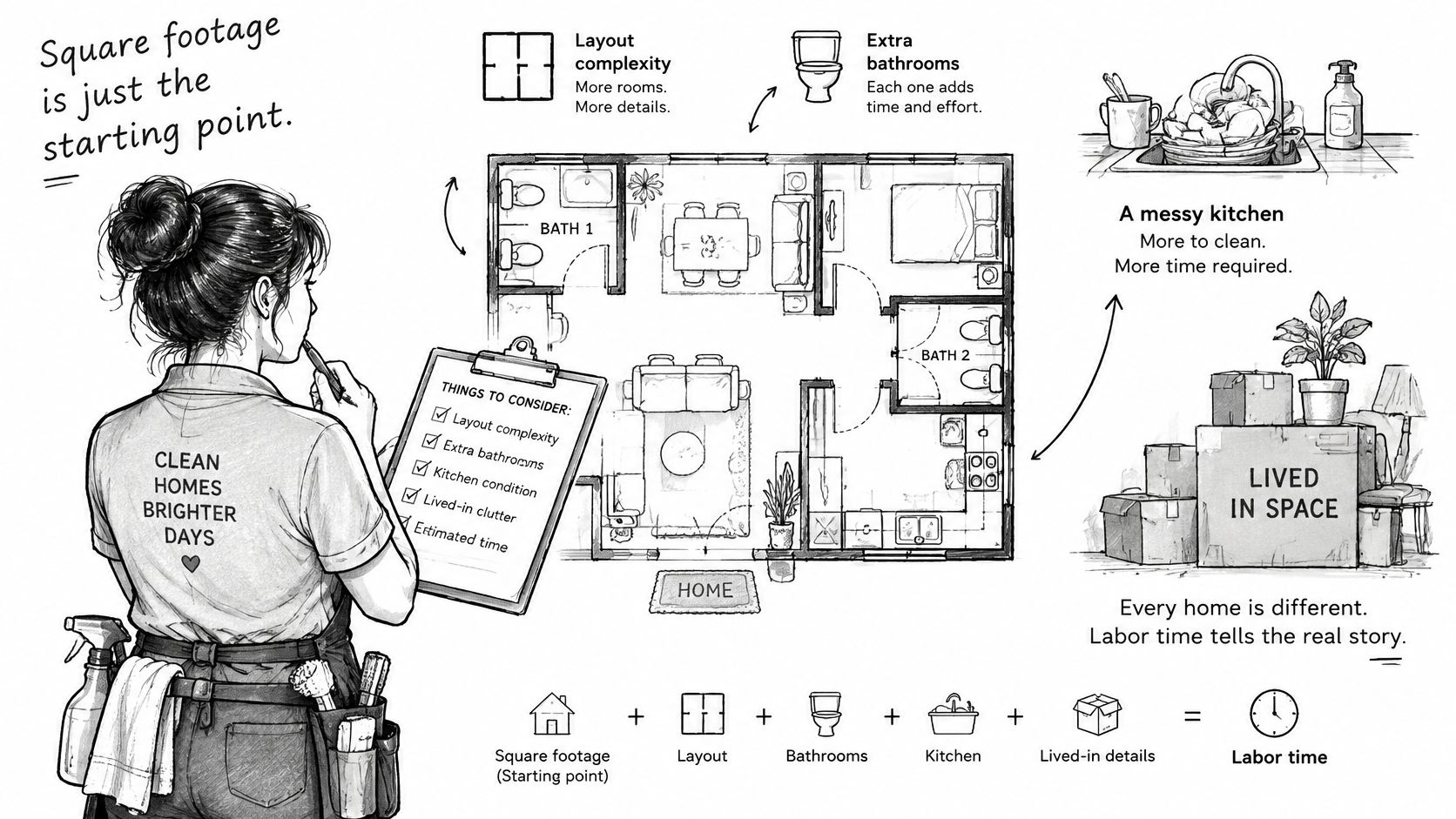
The drivers that change the hours
Layout beats raw size. An open plan can be faster than a warren of small rooms. An open 1,200-square-foot apartment may take less time than a 900-square-foot home with five separate rooms and two baths.
Condition adds minutes. Pets, dust, clutter, and built-up grease slow every surface. A stovetop with a season of splatter may need a different product and a longer slot than last month's light film.
Frequency changes the per-visit load. A recurring booking is usually cheaper per visit because the first visit carries the heavy soil. After that, the team is maintaining, not catching up.
The first visit can reclassify the job. A neglected kitchen can push a standard quote into a deep-clean rate. That is not a bait switch if the written scope changes with it. It is a bait switch if the scope stays vague and the invoice jumps.
Place and supplies are line items. Travel time, local labor, and late-change fees belong in the quote. Some crews bring fragrance-free products. Others expect you to supply them, which moves cost onto you.
Wages set a floor under the bid. In May 2023, the Bureau of Labor Statistics estimated a mean hourly wage of $16.66 for maids and housekeeping cleaners. A separate BLS estimate put janitors and cleaners, excluding maids and housekeeping cleaners, at a mean hourly wage of $17.43. Training, travel, and insurance sit on top of those wages. A bid far under that labor reality may be skipping training, cover, or supplies.
Convert every quote to a price per visit on the same task list before you compare. A lower headline that drops the oven, the inside of the fridge, or the ventilation time is not the same purchase.
Quote Items and Red Flags to Check
A fair quote explains the labor, the scope, and the risk. Square footage alone does not. Use the seven items below as a scorecard. A good answer is specific enough that you could hand it to someone else and they would know what happens in the home.
| Quote item | What a good answer looks like | Red flag |
|---|---|---|
| Written scope | Room-by-room task list attached to the quote | Only the words standard clean with no task list |
| Pricing basis | Flat rate per visit or hourly rate with estimated hours and end time | Up to a number with no estimated hours |
| Insurance and bonding | Certificate of insurance and bond available on request | Refusal to share documents |
| Screening and training | Written screening and training policy for every cleaner | No answer on who enters the home |
| Supplies and chemicals | Named products, labels available, eco or fragrance-free option | Unlabeled bottles brought into the home |
| Damage and cancellation | Written claim process and cancellation window | Verbal promises only |
| Recurring terms | Clear rate per visit and frequency commitment | Low first-visit price with steep repricing later |
What a solid reply sounds like
On scope, you want rooms and tasks attached to the price, not a slogan. On price, a flat rate per visit, or an hourly rate with estimated hours and a finish time, lets you plan the day. "Up to" a number with no end time can grow after the team is already inside.
Insurance should be a certificate you can request, not a verbal assurance. Screening and training should say who is allowed in and how new cleaners are taught the method. Supplies should be named, labeled, and available in a fragrance-free option if someone in the home is sensitive. Unlabeled bottles are a safety problem, not a paperwork quibble, because nobody can tell you what was sprayed on a nursery shelf or a stone counter.
Damage and cancellation need a written window and a claim path. A first-visit discount is fine when the later rate is printed now. A steep reprice after you have handed over keys is the pattern to question.
Ask these points in writing. You then have a record if a task is missed or a bottle was not what you approved. Score each quote from zero to seven. Treat a red flag as a reason to ask again in writing, not as an automatic rejection, and not as something you should ignore because the number looks friendly.
Three Homes and the Right Choice for Each
These three households are illustrative. Each one shows how the written scope, not the headline, decides the bid.
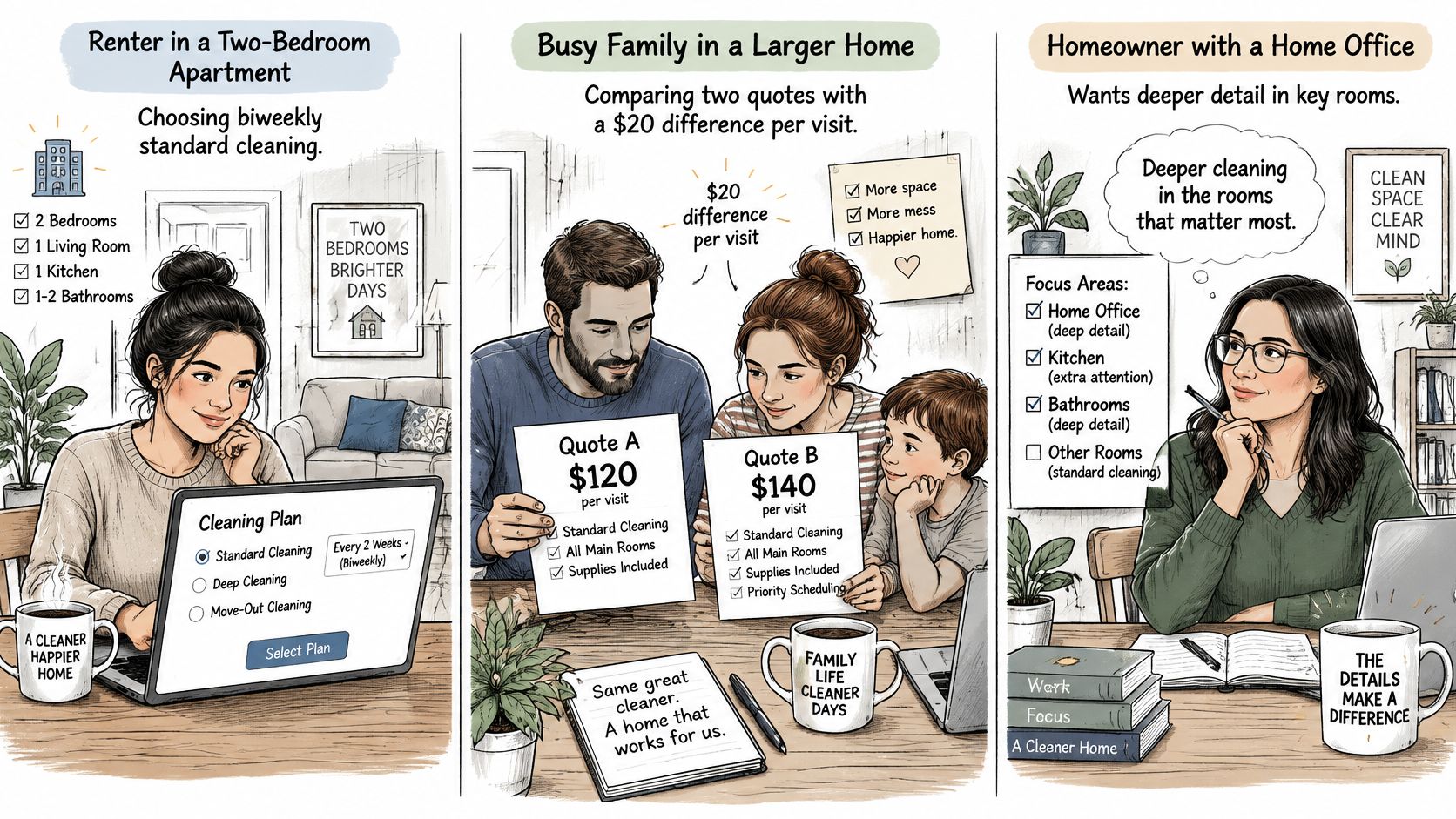
A renter comparing two standard bids
A renter in a two-bedroom apartment wants a biweekly standard clean. Her quotes differ by about $20 a visit. Quote A is a standard visit at $120 and leaves the fridge closed. Quote B is a standard visit at $150 and includes the inside of the oven and the fridge. Comparing them on price alone makes A look like the bargain. Once the extra appliance work is priced, B can be the better value, because hiring that work later as a separate call often costs more than the $30 gap. The question that settled it was simple. Does this price include appliance interiors, yes or no, on the same page as the total?
A family after a kitchen renovation
A family in a four-bedroom house with two dogs books a deep clean after the kitchen is renovated. Fine dust sits on vents, fixture rims, and baseboards, and dog hair holds it in the carpet edges. A quote that looks high may be the only one that names dust removal from vents and fixtures. A cheaper "deep clean" that skips those lines will leave a white film on every ledge by the next morning. They chose the post-renovation scope, expected a one-time price quoted by that dust load, and asked one question. Are vents and fixtures on the list, or only floors and counters?
A host with a same-day turnover
A short-term rental owner needs a checklist reset between guests, often with only a few hours before the next arrival, plus restocking of linens and basics. A weekly house plan does not match that clock. The right quote is per checkout, with beds, baths, kitchen, and restock named, and with a provider who can hit the window. The deciding question was whether the team could finish and restock inside the gap, in writing, not as a hope.
The pattern is the same in all three. The right provider is the one whose written scope matches your priorities at a fair price. A video walk-through of a full-home reset makes those task boundaries easier to picture before you book.
Confirm Your Scope Before Booking Your First Visit
You can settle this in one week if every provider sees the same brief.
- Write a three-line brief. Name the service type, the frequency, and the rooms that matter most. One line each is enough.
- Request a written task list from each provider. Build it from the inclusions you want, and send that same list to everyone so the quotes can be compared.
- Read price per visit next to scope. Never sort the inbox by the smallest number alone.
- Run the quote checklist. If a red flag appears, ask for a written answer before you choose.
- Book the plan you intend to keep. A discounted trial with different tasks, different products, or a different crew is not a test of the service you will live with.
- Walk the finished work against the list. Give specific feedback, such as "the shower track was missed" or "please skip fragrance in the nursery," so the next visit can change.
Keep the brief current
Review a recurring plan every few months. Pets, children, renovations, and guests change what the home needs. A scope that was right in spring can be thin after a kitchen project or too heavy once the catch-up work is done.
An accurate scope is worth more than a low headline price. A provider who answers scope questions in writing is usually one who will deliver what was promised, including how products go on and how long the windows stay open afterward.
If the visit is meant to leave walls, shelves, and framed pieces ready to enjoy, match the art to the room once the dust is gone. Printano Art prints and frames museum-quality work from a large artist catalog, with size and orientation options and free worldwide shipping, so you can choose a piece that fits the wall you just had cleaned. Browse Printano and pick a print for the room you care about most.